Lit. “The Night of Decree.”
Bismillah.
Introduction
Allah ﷻ says in His Book:
إِنَّآ أَنزَلْنَـٰهُ فِى لَيْلَةِ ٱلْقَدْرِ، وَمَآ أَدْرَىٰكَ مَا لَيْلَةُ ٱلْقَدْرِ، لَيْلَةُ ٱلْقَدْرِ خَيْرٌۭ مِّنْ أَلْفِ شَهْرٍۢ
“Indeed, We sent it [i.e., the Qur’ān] down during the Night of Decree. And what can make you know what is the Night of Decree? The Night of Decree is better than a thousand months.” (Surah al-Qadr 97:1–3)
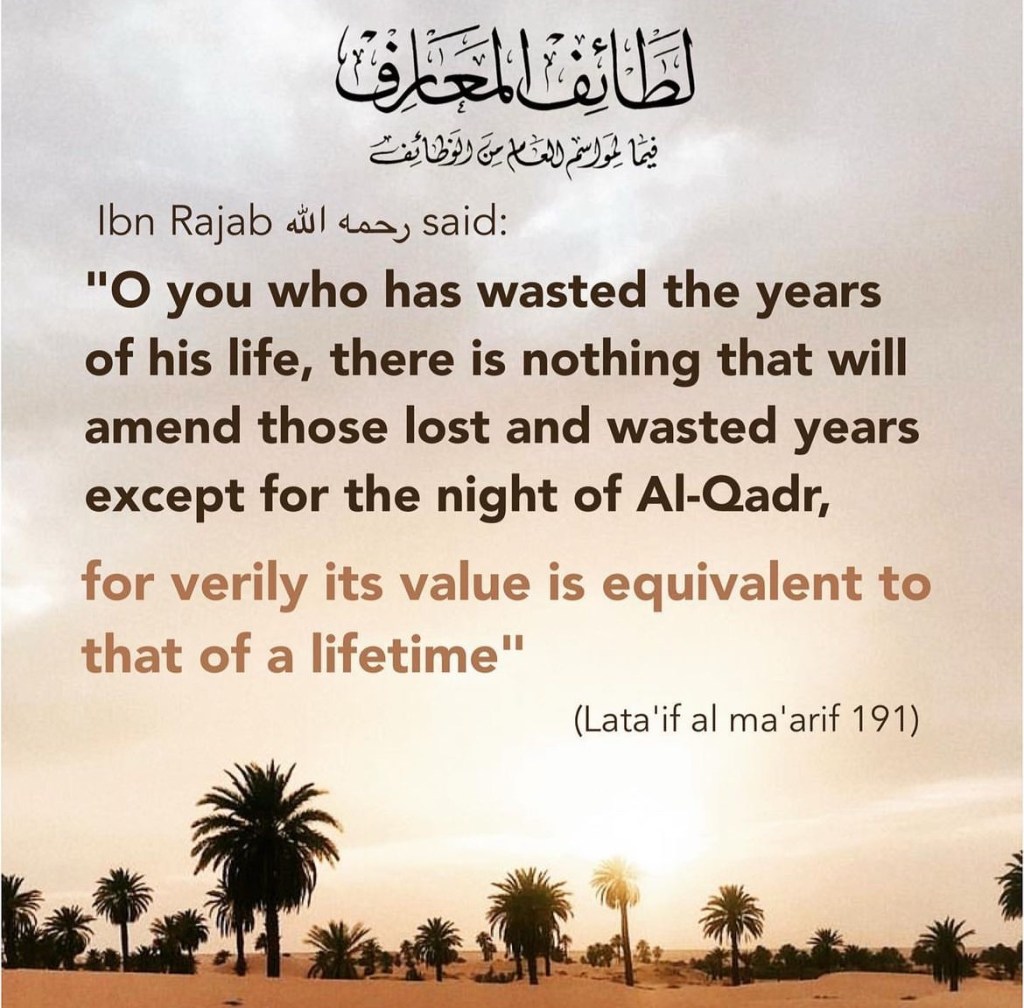
Laylatul Qadr is the most virtuous night of the year. It is the night in which the Qur’ān was revealed and in which decrees are apportioned by the permission of Allah.
Worship performed during the Night of Al-Qadr is equivalent to worship carried out over a period of one thousand months.
The Messenger of Allah (ﷺ) encouraged the Ummah to seek it during the last ten nights of Ramadan—particularly the odd nights—devoting themselves to increased prayer, supplication, and repentance because of its immense virtue.
Aḥādīth
Narrated ʿUbādah ibn As-Sāmit (رضي الله عنه):
“Allah’s Messenger (ﷺ) went out to inform the people about the date of the Night of Decree (Laylatul Qadr), but a quarrel occurred between two Muslim men. The Prophet (ﷺ) said, ‘I came out to inform you about the date of Laylatul Qadr, but since these two quarrelled, its knowledge was taken away. Perhaps that is better for you. Now seek it in the 5th, 7th, or 9th night of the last ten nights of Ramadan.’” [Sahih al-Bukhari 49]
Narrated `Aisha (رضي الله عنها):
“Allah’s Messenger (ﷺ) said, ‘Search for the Night of Qadr in the odd nights of the last ten nights of Ramadan.’” [Sahih al-Bukhari 2017]
Narrated Ibn `Abbas (رضي الله عنهما):
“The Prophet (ﷺ) said, ‘Look for the Night of Qadr in the last ten nights of Ramadan, on the night when nine or seven or five nights remain out of the last ten nights of Ramadan (i.e., 21, 23, 25, respectively).’” [Sahih al-Bukhari 2021]
Supplication During Laylatul Qadr – Tafsir Ibn Kathir
It is recommended to supplicate often at all times, especially during the month of Ramadan, in the last ten nights, and during its odd nights, even more so. It is recommended that one recite the following supplication frequently:
اللَّهُمَّ إِنَّكَ عَفُوٌ تُحِبُّ الْعَفْوَ فَاعْفُ عَنِّي
Allaahumma Innaka ‘Afuwwun Tuhibbul-‘Afwa Fa’affoo ‘annee.
“O Allah! Verily, You are the Oft–Pardoning, You love to pardon, so pardon me.”
This is due to what Imam Ahmad recorded from Aisha (رضي الله عنها), who said: “O Messenger of Allah! If I find the Night of Al-Qadr, what should I say?”
He (ﷺ) replied, Say: “O Allah! Verily, You are the Oft-Pardoning, You love to pardon, so pardon me.” [Ahmad 6:182]
Al–Hafidh Ibn Rajab [d. 795H] (رحمه اللّٰه) said:
“Al-‘Afuww is from the Names of Allah, He is the one who pardons the sins of His servants, wiping out their traces. He loves al-‘Afuww; He loves pardoning His servants often, and He loves that His servants pardon one another. For if His servants pardon one another, He will treat them with His ‘Afuww; His pardoning often is more beloved to Him than His Punishment.” [Latā’if al-Ma’ārif, p 466.]
References
Qurʾān Verses: The Virtue of Laylatul Qadr
• Qurʾān, Surah Al-Qadr, 1–3.
Ḥadīth: The Wisdom of Concealing Laylatul Qadr
- Sahih al-Bukhari, no. 49.
Ḥadīth: Seeking Laylatul Qadr
- Sahih al-Bukhari, no. 49.
- Sahih al-Bukhari, no. 2017.
- Sahih al-Bukhari, no. 2021.
Ḥadīth: Supplication for Laylatul Qadr
- Tafsir Ibn Kathir, commentary on Surah al-Qadr (97).
- Jamiʿ at-Tirmidhi (hasan sahih); see Tuhfat al-Ahwadhi, 9:495.
- As-Sunan al-Kubra (An-Nasa’i), 6:218.
- Sunan Ibn Majah, 2:1265.
- Al-Mustadrak ʿala as-Sahihayn, 1:530 — recorded with a different chain of narration; declared authentic according to the criteria of al-Bukhari and Muslim.
Scholarly Reference
- Lata’if al-Maʿarif, p. 466.
May Allah ﷻ write us among those freed from the Fire and whose sins are completely erased. 🌙
Aameen!
 The Enduring Good Deeds